Brewhouse Murals
The first murals at Kenwood appeared in 1928, painted by Roger Bland, the son of Lord Iveagh’s secretary, as Julius Bryant tells us in his catalogue of the Iveagh Bequest. The paintings were blue and white, ‘willow pattern’ depictions of Hampstead and coincided with a general revival in mural painting in both public and private spaces, such as those executed by Rex Whistler for the Tate Gallery restaurant (1926–7) and the decorative panels by Edward Bawden and Eric Ravilious for the walls of the refectory of London’s Morley College (1930).
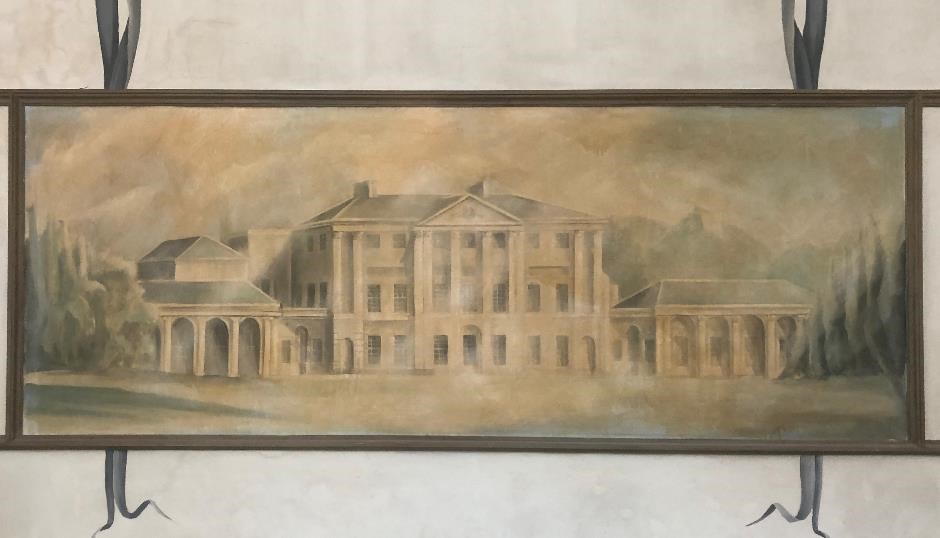
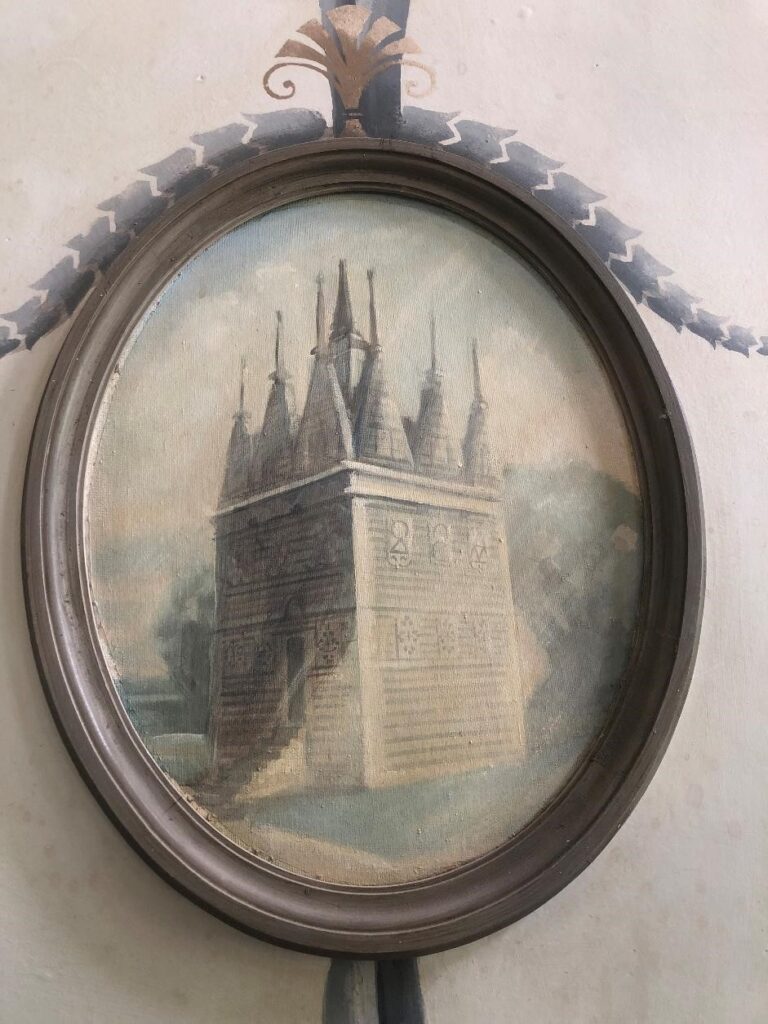
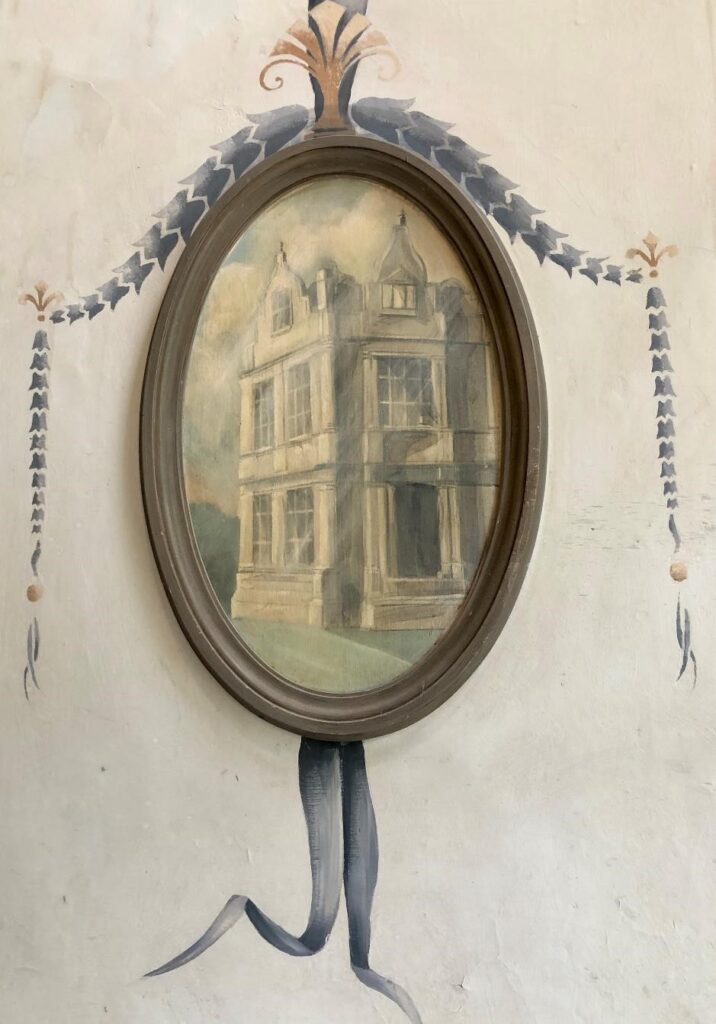
By the 1950s, Bland’s paintings had already been whitewashed due to deterioration and it was not until 1990 that English Heritage tendered for a new set of murals celebrating EH properties, especially four in London – Marble Hill, Chiswick, Kenwood and the Ranger’s House. The work was to be carried out quickly and with minimal disruption to the operation of the café. Decorative artist Christopher Boulter had the brilliant idea of painting a series of vignettes and arabesques on canvas in the studio, installing these in thin frames, and adding the surrounding trompe-l’oeil architectural decoration on-site. Boulter was duly awarded the commission and completed the work in only four months.
The style is a free interpretation of the neo-classical Adam idiom, suggested of course by Adam’s association with Kenwood, but perhaps it is also influenced directly by the bolder style of wall paintings at Pompei. We have cartouches surrounded by decorative ribbons, putti, scrolls and urns, and the whole is bathed in a peculiarly English subdued, watery light. The artist said at the time of his work: ‘Easel painters often make the mistake of thinking of wall-painting in the same way, in two dimensions. But my work is for rooms – for three dimensions. You have to try to create an ambience rather than an accurate representation. It’s much more like theatrical decoration’.
In 2019, Friends of Kenwood agreed to pay for the restoration of the murals to coincide with the general refurbishment of the café, and the contract was awarded to London firm Virtu Conservation Housekeeping. The remit was to conserve the 1990 murals while preserving any remnants of the 1928 scheme.
The conservators found the walls covered in thick layers of dust and cobwebs and there were greasy deposits and splashes, commensurate with the room’s use as a café. There was also evidence of many interventions over the last 30 years, including varnish spills and retouching.
The first stage of the project was to dust vacuum the surfaces, clean with water on soft sponges and then dry with microfibre cloths. Flaking and detached paint was then consolidated with dispersion adhesive applied with pressure. Japanese paper was applied with adhesive to conserve remnants of the original wall painting scheme and a filler was used to even up all surrounding surfaces. Finally, re-touching was carried out using acrylic paints supplied by specialist conservators Paine & Stewart.
Nick Fielding