

Relighting Kenwood
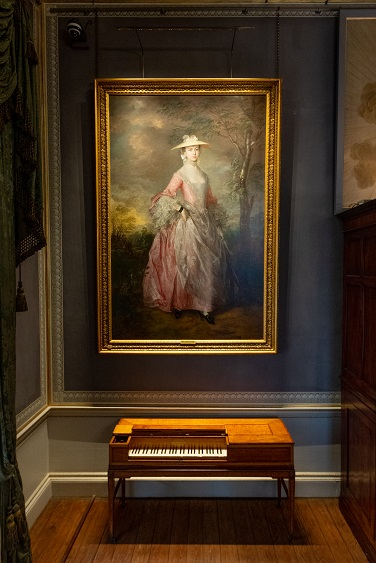
Replacing the old picture lights in the four wing rooms had long been on the wish list of Kenwood’s curators, past and present. The traditional hooded lights dated from the time of the last major refurbishment of the rooms, carried out in 1999–2000. Lit using tungsten-halogen bulbs, it required virtually constant maintenance to replace burnt-out lights. In the case of those paintings hung at ceiling height or otherwise made inaccessible by significant items of furniture, this meant specialist art handlers were needed to facilitate bulb replacement. The on-going cost to English Heritage of contracting such specialists meant that bulb replacement could only be undertaken once a quarter, sometimes leaving whole paintings in the dark for weeks or even months. Additionally, after more than twenty years, many of the picture lights in the wing rooms had begun to fail completely; fittings had ceased to work even with new bulbs and in some cases, the luminaires themselves had begun to physically disintegrate.
After a fantastically efficient funding-raising campaign by the Friends of Kenwood, topped up by funds generated through the Kenwood second-hand bookshop, the project to commission and install new picture lights began in late 2021. Leading art lighting specialists, TM Lighting were appointed in November, having previously worked with English Heritage at Apsley House and as lighting partners on the 2019 Rembrandt #nofilter display at Kenwood. In collaboration with English Heritage curators and paintings conservators, TM devised an innovative approach to picture lighting at Kenwood using their Slim Light Pro; the first time this ultra-sleek and contemporary picture light has been widely utilised in a historic interior. Following manufacture in Britain, the installation of the new picture lights got underway in the Music and Green Rooms in late January 2022, swiftly followed a month later by works in the Dining Room, including a rehang of the paintings.
The transformative effect of the new picture lights will be apparent to anyone familiar with Kenwood and its masterpieces. Stand in front of Vermeer’s The Guitar Player and for the first time you’ll readily be able to spot the artist’s monogram just below the window sill (no torch required!). Or contemplate Mrs Johnstone as Contemplation by Henry Raeburn and perhaps for the first time, you’ll notice the path leading to a mausoleum in the background – the final resting place of Mr Johnstone, whose portrait Mrs Johnstone is contemplating. The viewer’s understanding and appreciation of the painting is transformed by great lighting. But how exactly? TM Lighting’s picture lights are specifically designed to address the inefficiencies presented by poor quality lighting and dated technology often found in historic buildings. They utilise the latest LED technology with a colour rendition (CRI) of 96+, meaning that under the new picture lights, the colours in the paintings appear almost exactly as they would in natural sunlight. Colour temperature – the warmth of light – was also carefully selected to suit the specific environment at Kenwood. Finally, the optics used in TM’s picture lights ensure a visually even distribution of light across the whole surface of a painting, allowing previously murky details, like Mr Johnstone’s mausoleum, to emerge from the shadows.
In addition to the improved viewing experience, the new picture lights come with other important benefits, particularly in relation to the care and conservation of Kenwood’s masterpieces. Many of the materials used to make works of art can degrade over time as a result of exposure to light, so for decades, curators and conservators have had to balance the risk of possible long-term degradation against the need to see the paintings. Thankfully, TM Lighting ensures that it only utilises LEDs that emit light within the visible light spectrum, removing the more damaging portions of the light spectrum, such as infrared and ultraviolet. This helps to prevent fading of certain pigments. Additionally, unlike tungsten-halogen bulbs, LED’s emit negligible forward heat, making them optimal for use in the display of artwork because they do not cause fading or other heat damage to paints or dyes.
Last but certainly not least, the replacement of traditional incandescent bulbs with energy-efficient LED technology has significant energy saving and sustainability benefits. Owing to the high lumen output per watt, LEDs are capable of turning about 70% of their energy into light. This makes them much more efficient than other bulbs, which waste energy by turning it into heat. It takes only a 6 watt LED bulb to produce the same amount of light as a 40-watt incandescent bulb, and the lower temperature makes them safer to operate in a heritage environment. Additionally, the components of an LED and the way that they generate light significantly extend the lifespan of the bulbs by thousands of hours, making them more sustainable than traditional bulbs. One of our key strategic priorities at English Heritage is to minimise our negative impact on the natural environment, focusing on energy reduction, renewables, environmental management and new standards for sustainability. The new TM picture lights installed at Kenwood use only around 300 watts in total, versus the old picture lights, which used a minimum of 1000 watts, making for an energy saving of 70 per cent. The longer lifespan of LED bulbs – around 50,000 hours Vs 1000 hours for incandescent lamps – not only means greater sustainability but also results in less art handling for the installation of replacement bulbs, thereby reducing physical risk to the collection.
The project to relight the treasures of the Iveagh Bequest has been a transformative one in so many ways and will benefit Kenwood, our visitors and English Heritage for years to come. None of this would have been achieved without the Friends of Kenwood.
Louise Cooling – Curator of Collection & Interiors, Kenwood
Please see here a letter acknowledging Friends’ help:


