

Brew House Garden Obelisks
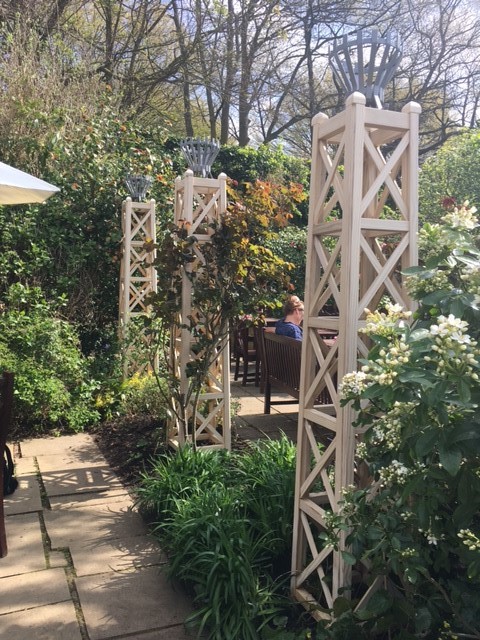
The Friends of Kenwood funded entirely the project to install new obelisks in the Brew House Garden (2017)
In 1999, award-winning English garden designer Lady Arabella Lennox Boyd kindly donated her expertise to English Heritage to create the beautiful Brew House Garden which we see today. It was completed in 2000, by which time tons of soil had been excavated, new beds created, flagstones re-laid, and – to finish off the design – large obelisks installed to support newly-planted roses. Since then, it has regularly featured in tourist guides and newspaper articles as one of the most captivating outdoor places in north London to have coffee, lunch or tea.
The Garden is considered to be an important feature of the Kenwood Estate and is included in the Kenwood Landscape Management Plan. It has become part of the modern landscape which draws visitors to Kenwood.
However, the exquisitely designed obelisks were made of softwood, and rotted away. They were removed and hazel stakes supported the roses as best they could. Kenwood’s recently retired Head Gardener, Paul Jackson, had been concerned for several years about ‘design creep’: with the disappearance of the obelisks, the designed nature of the Brew House Garden became less distinct and, while all gardens develop and change, it seemed a shame to lose a unique concept.
We were therefore delighted that we have been able to commission and fund the replacement of the obelisks. The design is exactly that of the original obelisks, English Heritage had all the original drawings and supporting documents in the archive. After considerable research, we discovered accoya – a stable, sustainable wood from managed forests, virtually maintenance-free and guaranteed for 50 years out of the ground and 25 years in the ground/freshwater (it is the wood commonly is used in piers).
On Lady Arabella Lennox Boyd’s recommendation, we contacted the master cabinet maker and craftsman who has his workshop on her estate, Luke Ham of Lancaster Woodcraft. To be able to use someone who works so closely with the original designer was very reassuring. Luke put many hours of skilled but often repetitive work into the re-creation of the obelisks, as you will see from the photos. Every joint is a mortice and tenon, much stronger than screws.
The metal baskets which are on the new obelisks are the original baskets, they had not deteriorated at all; to complete the design, rope swags hang between some to allow replanted clematis to find a foothold.
Jerzy Kierkuc-Bielinski


