

Buckland Caravan
On the edge of Hampstead Heath surrounded by tranquil landscaped gardens, Kenwood is one of London’s hidden gems. Within the breath-taking interiors of Robert Adam’s striking neo-classical villa, built for William Murray, 1st Earl of Mansfield, paintings by Rembrandt, Vermeer, Gainsborough, Reynolds and Turner are displayed alongside a fine collection of eighteenth-century decorative arts. However, in Kenwood’s Coach House, a more unusual work of art is to be found.
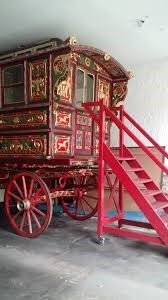
Since the late 1940s, Kenwood has been home to a rare ‘Gypsy’ caravan, the only example still to be found in London. The ‘Buckland Caravan’, which takes its name from its original owners, was built in around 1905 by Dunton and Sons, well-known caravan builders of Reading. Founded in the late nineteenth century by Samuel Dunton, the firm began making their first living-wagons in the 1880s and built some of the finest vehicles of their kind.
Horse-drawn caravans were first built for travelling show people in the early nineteenth century. By 1850, the Romanichal community had begun to use them, having previously travelled on foot, or in light, horse-drawn carts under which they would sleep. Known as ‘vardos’ in the Romani language, these caravans evolved into some of the most advanced forms of travelling wagon and became an iconic symbol of Romanichal culture.
A number of different styles of vardo developed in the second half of the nineteenth century. The ‘Reading’ was originated by Dunton and Sons and was among the most popular with the Romanichal community. The Buckland Caravan at Kenwood is a rare example of a ‘Ledge’ or Cottage Van, so-called because the body is built out over the large rear wheels. This has the advantage of allowing the caravan to turn within its own length, as well making the interior compartment more spacious.
Leonard and Ivy Buckland, who commissioned this caravan, were travelling show people of partly Romani descent. It is likely that they ordered the caravan from Dunton and Sons on the occasion of their marriage, as was customary in Romanichal culture. The building of a vardo took on average six months to a year to complete; at Dunton and Sons, William ‘Bill’ Dunton was responsible for work on the body of the van. A variety of woods, including oak, ash, elm, cedar, and pine were used for different parts of the caravan, utilised for their unique properties. For example, the wheel hubs of the Buckland Caravan, known as naves or stocks, are made from elm, the interlocking grain of which makes it resistant to splitting, while the fifty-two spokes of the wheels are made from knot-free oak, with the grain running end to end for strength. Brass brackets support the frame of the wagon, which has a solid arched roof with a central ‘mollicroft’; at twelve feet high, this adds extra head room, as well as top light and ventilation via the clerestory windows. The roof extends over the length of the caravan to create a porch at both front and back, supported on ornately carved brackets.
Albert and George Dunton were likely responsible for the painted and gilded decoration of the exterior of the caravan. Vardos were prized not only for their practicality but also for the beauty of their rich decoration. The Buckland Caravan is a particularly lavish example, featuring hand-carved panels, ornately painted and embellished with gold leaf. The design of the decorative panels was usually decided by the commissioning family and incorporated traditional symbols of the Romani lifestyle, such as horses and dogs, with more generic motifs including birds, lions, flowers, vines and elaborate scrollwork. The use of horses in the decoration of the Buckland Caravan not only reflects the ancient link between horses and the Romani people, but also the occupation of the Buckland family, who were the owners of a steam-powered merry-go-round, which they took to travelling fairs.
The fine craftsmanship of the Buckland Caravan continues inside, where the interior decoration includes inlaid mahogany panelling, ornate mirror glass and a carved and painted ceiling featuring a design of birds and flowers. The layout of the cabin reflects the standard adopted by most vardo builders, featuring built-in seats with drawers beneath, two glass bow-fronted cupboards, a chest of drawers with a French polished mahogany top, which could double as a table, and a shallow glass-fronted china cabinet for storing tableware. The cast-iron stove, made by R.H. Mellor and Sons of Owl Lamp Works, Oldham, was invented in America in the 1830s; its small size made this model ideal for living-wagons and they were a fixture by the late nineteenth century. Above the stove is an over-mantle mirror, which hides an airing cupboard accessed from either side. A slatted area at the rear when pulled out to the edge of the stove forms a double bed across the width of the wagon, with a small area beneath for children. A mirrored partition provided privacy for the occupants, while also giving the illusion of space and reflecting the light from the coloured clerestory windows above. As well as adding a further touch of luxury, these coloured windows served as a rudimentary safety feature, as the rear window was fitted with red glass so that it served as a warning light when the interior lamps were lit at night.
Each summer, Leonard and Ivy Buckland and their children would travel in the caravan from their home in Buckingham to fairs in the surrounding area, spending about a week in each location. The caravan would have been pulled by a single horse at a steady pace of 2mph; the large wheels keeping it clear of water. To manage steep hills an extra horse could be lashed to the side of the van to provide extra pulling power.
In late August, the Bucklands would take their travelling merry-go-round to the Hampstead Heath Fair, where they became a familiar sight to local residents. Leonard Buckland was known to play the violin, adding to the atmosphere, while the caravan itself, with its lavish decoration also acted as an attraction to children and adults alike. Fairs had been held on Hampstead Heath since the 1860s and following the Bank Holidays Act of 1871, huge crowds would gather in May and August to enjoy the fair, which at its height, covered the whole of East Heath to Spaniard’s Road. By the 1890s, ‘Appy Ampstead’ was known nationally and was celebrated in song by musical hall favourite Albert Chevalier (1861-1923) and in the cartoons of caricaturist Phil May (1864-1903). In 1910, when the Bucklands and their merry-go-round were likely among the attractions, as many as 200,000 people attended the fair, with an estimated 50,000 arriving by rail alone.
It was while the Bucklands were at the Heath Fairs that they met and became friends with Mrs Muriel Mason, who worked as a wood engraver and painter under her maiden name, Muriel Jackson (1901-1977). Jackson was a resident of Hampstead and from 1920 she specialised in recording Romani vardo on the Heath. The Buckland Caravan features in several of her works. In the early 1930s the Bucklands retired from actively travelling and their caravan was kept in storage until 1938, when they sold it to Muriel Jackson, with whom they had remained in contact. The Mason family kept the caravan in their garden before presenting it to London County Council in 1948. For much of the late twentieth century, the Buckland Caravan was displayed outdoors, so that by the mid-1970s it was in need of restoration, after which it was brought indoors. In 1997, English Heritage commissioned the specialist cleaning and conservation of the Buckland Caravan. Today, it is kept in the Kenwood Coach House, designed by the architect George Saunders and built between 1793 and 1797 for David Murray, 2nd Earl of Mansfield (1727-96). Although not regularly accessible to the public, visitors can view the Buckland Caravan, along with Lord Iveagh’s ‘four-in-hand Drag’ when the Coach House is open to the public during Open House Weekend, held annually in September (21-22 September 2019).
Louise Cooling


